
How technology reshapes our relationship with history #81
An exploration of how technology is transforming memory, from analog scarcity to AI-mediated, relational, and even biological forms of remembering.
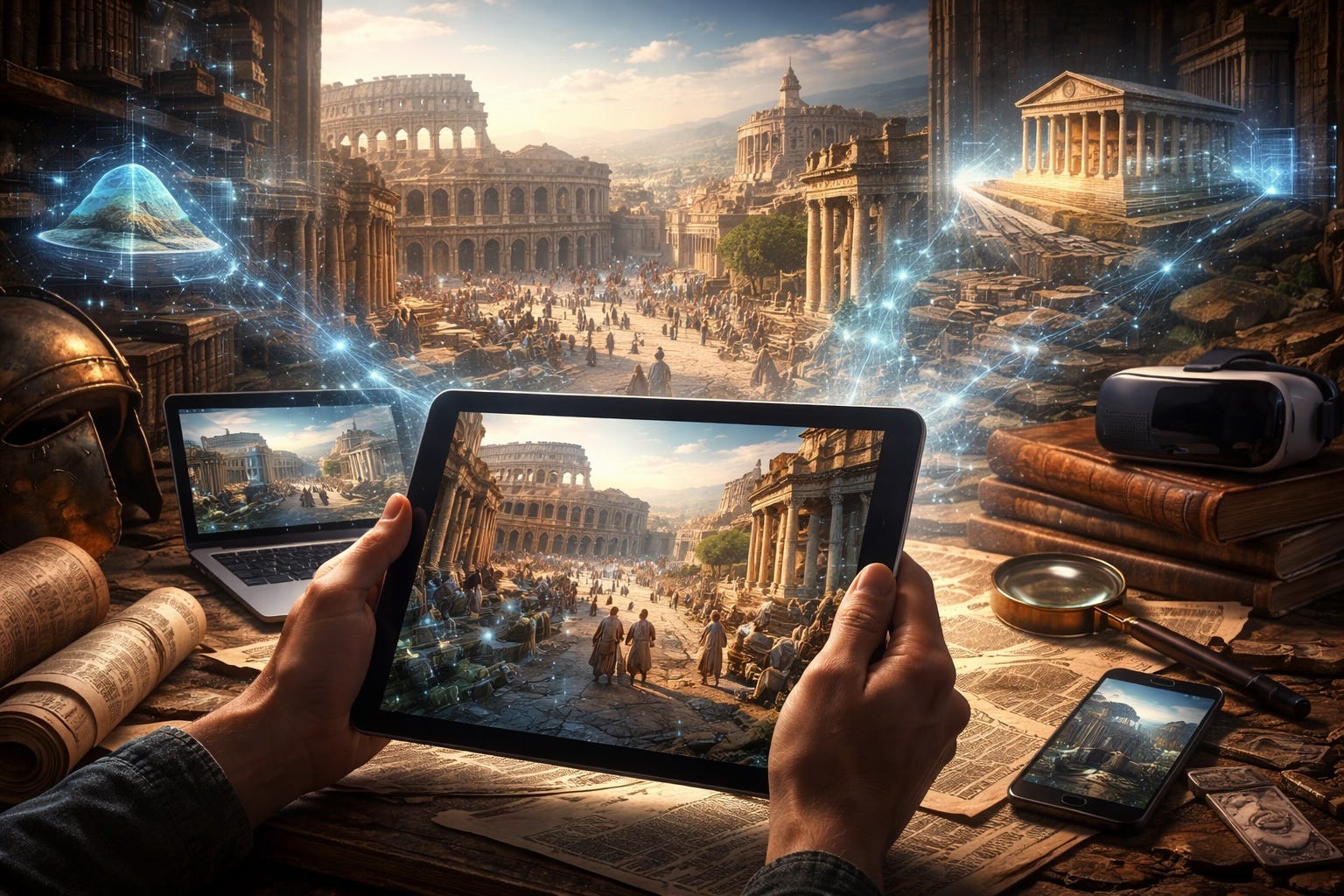
The question of how we remember has never been merely technical. Throughout human civilization, memory has served as the fundamental architecture through which we construct identity, transmit culture, and make sense of our place in the continuum of time. Yet today, at the intersection of artificial intelligence, neural interfaces, and digital cloning technologies, we face a transformation in this relationship more profound than any previous shift in human history. The question is no longer simply what we remember, but fundamentally how we relate to the very concept of remembering itself.
We’re witnessing not just an evolution in information technology, but a series of discrete epochal shifts in the nature of memory as a human faculty. Each technological revolution doesn’t merely change our tools for accessing the past; it fundamentally restructures the cognitive and social frameworks through which memory operates. To understand where we’re heading requires examining not just where we are, but tracing the direction through which we arrived here.
The analogical foundation
Before the digital revolution fundamentally altered our information landscape, memory existed within an ecosystem of profound scarcity. The knowledge of the past resided in physical artifacts that required deliberate effort to access: libraries with their carefully cataloged collections, archives preserving fragile documents, and perhaps most importantly, human witnesses whose lived experiences represented irreplaceable nodes of historical understanding. This scarcity wasn’t merely an inconvenience to be overcome; it structured the entire social and cognitive architecture of how we related to memory.
The analogical era established what we might call authority through difficulty. When accessing information required physical presence in specific locations, when consulting a historical text demanded navigating card catalogs and physically retrieving volumes from shelves, when learning about events necessitated identifying and speaking with knowledgeable individuals, the very friction of this process conferred legitimacy on the information obtained. Teachers, historians, and storytellers didn’t just transmit knowledge; they served as essential mediators whose expertise lay not merely in what they knew, but in their ability to navigate this landscape of scarcity and synthesize disparate fragments into coherent narratives.
This system possessed virtues that become apparent only in retrospect. The slowness inherent in analogical research encouraged depth rather than breadth. When each piece of information represented significant investment of time and effort, there existed a natural incentive toward careful consideration and integration of knowledge rather than superficial accumulation. Memory operated as a profoundly social practice, embedded in relationships between teachers and students, researchers and archivists, storytellers and audiences. The process of remembering wasn’t merely individual retrieval but collective negotiation of meaning.
Yet we cannot romanticize this era without acknowledging its limitations. The same scarcity that encouraged depth also enabled forgetting and distortion. Historical narratives were vulnerable to the biases of those who controlled access to sources. Entire populations and perspectives could be systematically excluded from collective memory simply through lack of documentation or deliberate suppression of records. The analogical era’s depth came at the cost of incompleteness, its authority sometimes masking profound gaps and distortions in the historical record.
When everything became searchable
The emergence of the internet and digital search technologies didn’t merely make existing information more accessible; it fundamentally inverted the information economy from scarcity to abundance. Where previous generations faced the challenge of locating scarce information, we now confront the opposite problem: filtering signal from an overwhelming noise of available data. Search engines transformed our relationship with knowledge from one of acquisition to one of navigation, and this shift carried implications far beyond mere convenience.
The transition to digital search established what I call externalized memory architecture. Rather than internalizing information, we increasingly internalize search strategies and navigational frameworks. The crucial cognitive skill becomes knowing where and how to find information rather than retaining the information itself. Bookmarks, cloud storage, and platforms like Wikipedia represent extensions of cognitive capacity, creating a hybrid human-digital memory system where the boundaries between what we remember and what we can access blur significantly.
This externalization brings undeniable advantages. The democratization of access to information represents a genuine revolution in human capability. Historical documents once accessible only to privileged researchers are now available to anyone with an internet connection. The ability to cross-reference sources, trace citations, and access multiple perspectives on historical events has transformed both professional historiography and popular historical understanding.
However, this abundance creates its own pathologies. Digital information tends toward fragmentation, presenting isolated facts divorced from the narrative context that gives them meaning. The ease of access can encourage superficial engagement, where we skim multiple sources without deeply comprehending any single perspective. The phenomenon of “knowing where to look” replacing “knowing” itself creates a form of memory that is simultaneously more extensive and more shallow, broader but less integrated into coherent understanding.
The conversational turn
The introduction of artificial intelligence capable of natural language processing represents a qualitative leap beyond mere search and retrieval. Where digital search required us to formulate queries and navigate results, AI systems engage in dialogue, synthesizing information and adapting responses to conversational context. This shift from search to interaction transforms memory from something we access into something that responds to us, creating a fundamentally new relationship with historical knowledge.
Contemporary AI systems don’t simply locate information; they interpret, synthesize, and explain. When we ask an AI about a historical event, we receive not a list of sources but a synthesized narrative that draws from multiple perspectives and adapts to the specificity of our query. This represents memory that actively participates in its own transmission, creating explanations tailored to our level of understanding and specific interests.
This conversational capability introduces new forms of cognitive authority that diverge significantly from both the analogical era’s expert mediators and the digital era’s algorithmic ranking. The authority of AI-generated historical narratives derives from their apparent comprehensiveness and their ability to provide immediate, coherent responses to complex questions. Yet this very fluency masks significant challenges around accuracy, bias, and what I call “hallucinated history”, plausible-sounding narratives that blend accurate information with fabricated details.
The implications extend beyond individual accuracy to questions of how authority itself functions in our relationship with the past. When an AI can generate a compelling historical narrative on demand, synthesizing information in ways that appear authoritative, how do we maintain critical engagement with sources? How do we distinguish between synthesis based on genuine historical evidence and synthesis that reflects the statistical patterns in training data rather than historical reality? These questions aren’t merely technical but go to the heart of how we establish and maintain collective understanding of our past.
The empathetic mediation
The next frontier in this evolution moves beyond mere interaction toward what we might call relational memory: systems that don’t just respond to queries but recognize and adapt to the emotional and contextual dimensions of human engagement with history. This represents a shift from AI as information source to AI as empathetic mediator of historical understanding, capable of tailoring not just content but tone, emphasis, and narrative framing to the specific needs and state of the person seeking to remember.
Emerging AI systems demonstrate increasing capability to recognize emotional context, personal background, and individual learning patterns. Applied to historical memory, this creates possibilities for personalized historical narratives that adapt not just to what we want to know but to how we’re capable of receiving and integrating that knowledge in our current state. The same historical event might be presented differently to a student seeking to understand, a descendant seeking connection with ancestral experience, or a researcher pursuing analytical insight.
This personalization offers profound potential for making historical knowledge more accessible and meaningful. The ability to adapt explanations to individual learning styles, to recognize when someone is struggling with difficult historical material and adjust accordingly, to provide emotional support when engaging with traumatic history, these capabilities could transform how we transmit historical understanding across generations and communities.
Yet this very personalization introduces risks that demand careful consideration. When historical narratives adapt to individual emotional needs and preferences, we risk fragmenting collective memory into incompatible personal versions. The line between helpful contextualization and distorting pandering becomes perilously thin. If AI systems learn to present history in ways that maximize engagement or satisfaction rather than accuracy and nuance, we may find ourselves inhabiting increasingly divergent and potentially incompatible historical realities.
My concern here centers not on the technology itself but on the social and political frameworks within which it operates. Empathetic AI mediation of memory could genuinely enhance historical understanding and transmission, but only if we maintain rigorous commitments to accuracy, acknowledge uncertainty and multiple perspectives, and resist the temptation to use personalization as a tool for manipulation or simplified narratives that sacrifice complexity for palatability.
When the dead continue speaking
Perhaps no development challenges our traditional understanding of memory more profoundly than the emergence of digital cloning technologies: AI systems designed to replicate the communication patterns, knowledge, and even apparent personality of specific historical individuals. This represents memory that doesn’t merely preserve or transmit the past but simulates its continued presence, creating what we might call interactive monuments that blur the boundary between remembering and encountering.
These systems promise unprecedented access to historical perspectives. Imagine consulting a digital clone trained on the complete written works, speeches, and available biographical information about a historical figure, engaging in dialogue that draws from their documented positions while synthesizing responses to contemporary questions they never explicitly addressed. For educational purposes, for preserving cultural knowledge, for maintaining connection with recently deceased loved ones, such technology offers possibilities that previous generations could scarcely imagine.
However, I believe we must approach this capability with profound caution regarding its implications for historical authenticity and memory integrity. A digital clone isn’t the person it represents; it’s a statistical model of communication patterns that may capture surface characteristics while fundamentally misrepresenting underlying thought processes, values, and the ineffable qualities that constitute individual identity. When we interact with these systems, we’re not actually accessing the past; we’re engaging with a present-day simulation that reflects both historical data and the biases inherent in how that data was selected and modeled.
The risk of historical revisionism through digital cloning extends beyond simple inaccuracy to more subtle forms of distortion. These systems don’t preserve static memory but generate new content in response to interaction, creating a form of memory that evolves through dialogue. While this dynamism might seem to make history more relevant and engaging, it also opens possibilities for gradual drift away from documented positions, for smoothing over contradictions that were essential to the historical figure’s actual complexity, for projecting contemporary assumptions backward onto historical consciousness.
We must ask who controls these digital proxies for historical memory, who decides what training data shapes them, who has authority to update or modify them over time. The question of ownership and governance of digital clones carries implications not just for individual privacy and dignity but for our collective ability to maintain accurate and nuanced understanding of our shared past.
When memory becomes biology
The most speculative yet potentially transformative development in this trajectory involves neural interface technologies that could enable direct writing of information into biological memory. While current capabilities remain limited to relatively simple signals, the trajectory points toward possibilities that would fundamentally dissolve the boundary between external information and internal recall, between learning and knowing, between memory accessed and memory possessed.
Brain-computer interfaces promise capabilities that sound like science fiction: the ability to upload knowledge directly to neural tissue, to enhance recall capacity beyond biological limitations, to share memories between individuals as easily as we currently share files. This represents the ultimate externalization of memory, paradoxically through its complete internalization, bypassing all mediation between information and cognition.
The educational and therapeutic applications are easy to imagine. Instantaneous language acquisition, immediate access to technical knowledge, the ability to experience historical events through others’ neural recordings. These capabilities could revolutionize learning and expand human potential in unprecedented ways. For individuals with memory impairments or degenerative conditions, neural enhancement might restore capabilities and maintain identity in ways currently impossible.
Yet this is precisely where I believe we must exercise the greatest caution and ethical scrutiny. The ability to write directly to human memory doesn’t just raise questions about accuracy or bias; it challenges the fundamental basis of identity and autonomy. When memories can be implanted rather than experienced, what remains of the distinction between authentic personal history and fabricated recall? When knowledge can be downloaded rather than learned through effort and integration, what happens to the cognitive processes through which we develop understanding rather than merely accumulating information?
The question of who controls these technologies and under what constraints becomes absolutely critical. Direct neural writing of memory represents infrastructure for potential totalitarian control more complete than any previous technology. The ability to modify belief, rewrite personal history, or implant false memories would enable manipulation of human consciousness at a level that makes current concerns about algorithmic bias seem almost quaint by comparison.
This isn’t to argue against research into neural interfaces or to suggest these technologies are inherently dystopian. Rather, I’m arguing that their development demands governance frameworks and ethical considerations far more robust than we’ve yet established for any previous technology. The stakes involve nothing less than the preservation of human agency and the integrity of individual and collective memory as foundations of personal identity and democratic society.
Implications and the path forward
Tracing this evolutionary trajectory from analogical scarcity through digital abundance to AI-mediated interaction and potentially to neural integration reveals a consistent pattern: each technological shift expands access while potentially attenuating depth, increases capability while creating new vulnerabilities, and promises enhancement while risking fundamental alterations to human cognition and society.
The crucial insight isn’t that these changes are uniformly positive or negative, but that they require conscious, collective deliberation about what aspects of memory and historical understanding we value and wish to preserve. The slowness and difficulty of analogical research may have been inefficient, but they encouraged the careful consideration and synthesis that produces genuine understanding rather than superficial familiarity. The authority of expert mediators may have sometimes been misused, but it provided frameworks for evaluating credibility that we’ve yet to adequately replace in an age of information abundance.
My position is that we need to resist both technological determinism and reactionary resistance. The evolution of memory technologies will continue regardless of whether we approach it thoughtfully, but its specific trajectory and social implementation remain subject to human choice and collective governance. We can shape these technologies to enhance rather than replace human memory, to expand rather than fragment collective understanding, to democratize rather than concentrate control over historical narrative.
This requires several commitments. First, we must maintain and strengthen our capacity for critical engagement with sources and claims, developing new forms of literacy appropriate to AI-mediated memory. Second, we need robust frameworks for governing these technologies that prioritize transparency, accountability, and democratic input rather than leaving development solely to market forces or state control. Third, we should resist the temptation to treat memory enhancement as purely individual consumer choice and instead recognize it as social infrastructure with collective implications.
The question facing us isn’t whether technology will transform memory, that process is already well underway. The question is whether we’ll approach this transformation with sufficient wisdom to preserve what makes memory valuable while embracing genuinely beneficial capabilities. Our relationship with history and memory shapes who we are individually and collectively. As we enter an era where that relationship becomes increasingly mediated and potentially manipulated by powerful technologies, ensuring we remain active participants rather than passive subjects in how we remember becomes one of the defining challenges of our time.
We are reaching a moment in which the way we remember may take very different paths. Memory can open up, becoming more accessible and shared, or it can narrow, shaped and controlled by a few. Our relationship with history may grow richer and more meaningful, or it may weaken and fragment. What is ultimately at stake is not just how we remember, but how much agency we retain in shaping our own understanding of the past. The outcome depends not on the technologies themselves but on the choices we make about their development and deployment. This is perhaps the most important conversation we should be having about our technological future, because it’s ultimately a conversation about who we are and who we choose to become.
Even in this field, we only ad the beginning!
(Service Announcement)

This newsletter (which now has over 6,000 subscribers and many more readers, as it’s also published online) is free and entirely independent.
It has never accepted sponsors or advertisements, and is made in my spare time.
If you like it, you can contribute by forwarding it to anyone who might be interested, or promoting it on social media.
Many readers, whom I sincerely thank, have become supporters by making a donation.
Thank you so much for your support!