
Is artificial intelligence making us dumber? No. #49
The debate over technology’s effect on our minds deserves more than the usual wave of alarmist headlines.

(Service Announcement)

This newsletter (which now has over 5,000 subscribers and many more readers, as it’s also published online) is free and entirely independent.
It has never accepted sponsors or advertisements, and is made in my spare time.
If you like it, you can contribute by forwarding it to anyone who might be interested, or promoting it on social media.
Many readers, whom I sincerely thank, have become supporters by making a donation.
Thank you so much for your support, now it's time to dive into the content!
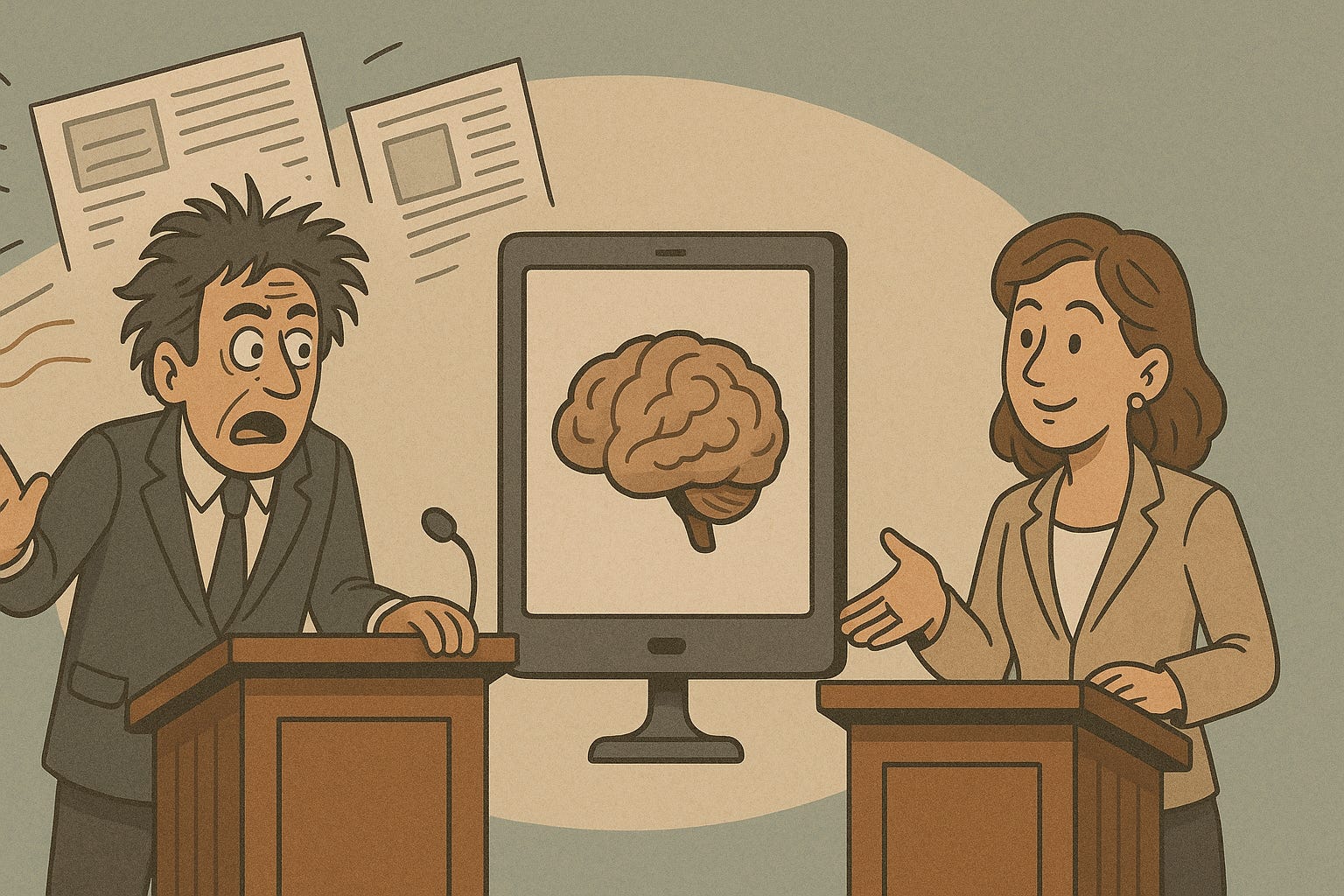
In the perpetual discourse surrounding technological advancement and its impact on human cognition, we find ourselves confronted with a paradox that demands deeper examination than the superficial alarmism that often dominates contemporary academic research. While recent studies, including a notable investigation by MIT researchers published in their paper "Your Brain on ChatGPT: Accumulation of Cognitive Debt when Using an AI Assistant for Essay Writing Task" have focused narrowly on documenting the apparent deterioration of specific cognitive functions when humans interact with artificial intelligence systems, they fundamentally misunderstand the broader evolutionary trajectory of human capability and the dynamic nature of skill transformation throughout our species' history.
The MIT study, which employed electroencephalography to measure brain connectivity during essay writing tasks, revealed that participants using Large Language Models exhibited weaker neural networks compared to those working without technological assistance. While such findings appear concerning on the surface, they reflect a limited perspective that fails to account for the fundamental reality of human adaptation: our species has never been defined by the preservation of static capabilities, but rather by our remarkable ability to evolve, adapt, and redirect our cognitive resources toward new frontiers of knowledge and creativity.
The historical precedent of skill evolution
To understand the current technological transformation, we must first acknowledge that skill evolution represents the natural progression of human development rather than a concerning departure from some idealized cognitive baseline. Consider the profound transformation that occurred when our ancestors transitioned from nomadic hunting and gathering to agricultural settlements. The intricate knowledge required for tracking prey across vast terrains, reading animal behavior patterns, and surviving in wilderness environments gradually became obsolete for most human populations. Yet this transition did not represent cognitive decline; instead, it marked the beginning of unprecedented innovations in tool-making, social organization, and agricultural science that ultimately enabled the development of complex civilizations.
The same evolutionary principle applies to more recent historical transitions. The invention of writing systems fundamentally altered human memory practices, as oral traditions that had required extraordinary feats of memorization gave way to external storage systems that freed cognitive resources for new forms of abstract thinking and knowledge manipulation. Similarly, the development of mechanical printing eliminated the need for the meticulous hand-copying skills that medieval scribes had perfected over decades of training, yet this technological advancement enabled the democratization of knowledge and the explosive growth of literacy that characterized the Renaissance period.
The industrial revolution provides another compelling example of this pattern. The sophisticated manual craftsmanship that had defined human production for millennia became increasingly mechanized, leading to concerns about the loss of traditional artisanal skills. However, this transition simultaneously created entirely new categories of expertise: mechanical engineering, industrial design, quality control systems, and complex supply chain management. Workers who might previously have spent their entire careers perfecting a single craft technique instead learned to operate, maintain, and improve sophisticated machinery that could produce goods at unprecedented scales and levels of precision.
The neuroscience of cognitive adaptation
The narrow focus on immediate neurological changes observed in studies like the MIT research fails to account for the brain's remarkable plasticity and its capacity for long-term adaptation to new cognitive environments. While EEG measurements may indeed show reduced connectivity in certain brain regions when individuals use AI assistance for specific tasks, this observation must be contextualized within the broader understanding of how human cognition adapts to technological tools throughout development and across generations.
When we examine the concept of "cognitive debt" proposed by such studies, we encounter a fundamental misunderstanding of how human intelligence actually functions in relationship to external tools and systems. The notion that using AI assistance creates a form of mental borrowing that must eventually be repaid assumes a zero-sum model of cognitive capacity that contradicts decades of research in cognitive science and educational psychology. Human intelligence has always been inherently collaborative and tool-dependent; our species' greatest achievements have consistently emerged from our ability to create and use external systems that amplify our innate cognitive capabilities rather than replace them.
The brain connectivity patterns observed in the MIT study, rather than indicating cognitive deterioration, may actually represent the beginning of adaptive processes that redirect neural resources toward higher-order thinking skills that become more relevant in AI-augmented environments. When individuals no longer need to devote cognitive resources to tasks like basic research compilation or initial content generation, those mental resources become available for critical evaluation, creative synthesis, and strategic thinking that represent uniquely human contributions to the collaborative human-AI knowledge creation process.
The amplification paradigm versus replacement anxiety
The critical distinction that emerges from a more nuanced analysis of human-AI interaction lies in understanding the difference between cognitive amplification and cognitive replacement. The MIT study's focus on measuring brain activity during isolated task performance overlooks the more significant question of how AI tools can be integrated into human cognitive processes in ways that enhance rather than diminish overall intellectual capability.
When individuals engage with AI systems after first engaging in independent reflection and analysis, the technology functions as a cognitive amplifier rather than a substitute for human thinking. This approach preserves and even enhances the neural activation patterns associated with creative problem-solving while simultaneously providing access to vastly expanded information processing capabilities. The key factor determining whether AI interaction leads to cognitive enhancement or cognitive atrophy lies not in the technology itself, but in how deliberately and thoughtfully individuals structure their engagement with these tools.
The concern about diminished sense of authorship observed in AI-assisted writing tasks reflects a transitional challenge rather than an insurmountable problem. As individuals develop more sophisticated understanding of how to collaborate effectively with AI systems, they learn to maintain intellectual ownership while leveraging technological capabilities. This process parallels historical adaptations to other transformative technologies: early automotive drivers initially felt disconnected from the mechanical processes that propelled their vehicles, but over time developed new forms of expertise in navigation, traffic management, and vehicle operation that represented different but equally valid forms of skill and agency.
The transformation of memory and information processing
The evolution of human memory practices provides a particularly illuminating example of how cognitive capabilities transform rather than simply deteriorate in response to technological advancement. The MIT study's observations about reduced neural connectivity during AI-assisted tasks echo historical concerns about the impact of writing systems on oral memory traditions. Ancient Greek philosophers, including Plato, worried that written language would weaken human memory capacity and reduce the depth of intellectual engagement with ideas.
However, the historical record demonstrates that the externalization of memory through writing systems actually enabled unprecedented advances in human intellectual achievement. By freeing cognitive resources from the task of information storage, writing allowed for the development of complex logical systems, mathematical reasoning, and abstract philosophical concepts that would have been impossible to maintain through purely oral traditions. The apparent "weakening" of memorization skills facilitated the strengthening of analytical and synthetic thinking capabilities that proved far more valuable for advancing human knowledge and civilization.
Contemporary concerns about digital devices replacing human memory functions follow a similar pattern. While individuals may indeed memorize fewer phone numbers or rely more heavily on GPS navigation systems, these changes free cognitive resources for other forms of learning and problem-solving. The neurological changes observed in brain imaging studies reflect the redistribution of cognitive effort rather than overall cognitive decline.
Modern neuroscience research has demonstrated that the human brain's capacity for adaptation extends far beyond simple skill substitution. Individuals who regularly engage with digital information systems develop enhanced capabilities in information filtering, pattern recognition across multiple data sources, and rapid evaluation of information quality and relevance. These emerging cognitive skills represent adaptations to information-rich environments that would have been impossible to develop in pre-digital contexts.
Cultural preservation within technological evolution
The relationship between technological advancement and cultural authenticity represents another dimension of the skill evolution phenomenon that requires careful consideration. While global algorithmic systems do create pressures toward homogenization, they simultaneously enable new forms of cultural expression and preservation that were previously impossible. Digital platforms allow for the documentation and transmission of cultural practices across geographical and temporal boundaries in ways that can actually enhance cultural diversity rather than diminish it.
The key factor determining whether technological systems promote cultural homogenization or cultural preservation lies in how these tools are designed and implemented. When AI and digital platforms are developed with explicit attention to cultural diversity and local knowledge systems, they can serve as powerful tools for maintaining and revitalizing traditional practices while also enabling their evolution and adaptation to contemporary contexts.
Indigenous communities around the world have demonstrated how digital technologies can be employed to preserve and transmit traditional knowledge systems while also facilitating their integration with modern educational and economic opportunities. Language learning applications that incorporate traditional storytelling methods, virtual reality systems that enable immersive experiences of historical cultural practices, and AI-assisted documentation of traditional ecological knowledge represent examples of how technology can serve cultural preservation rather than cultural replacement.
The future of human-AI collaboration
As we advance further into the era of sophisticated artificial intelligence systems, the challenge facing human society involves developing frameworks for interaction that maximize the benefits of technological capability while preserving and enhancing the uniquely human contributions to knowledge creation and problem-solving. This requires moving beyond the narrow focus on immediate task performance that characterizes studies like the MIT research toward a more comprehensive understanding of how human-AI collaboration can be structured to promote long-term cognitive and cultural flourishing.
The development of effective human-AI collaboration requires explicit attention to maintaining human agency and intellectual ownership within technologically mediated processes. This involves creating educational frameworks that teach individuals how to use AI tools as extensions of their thinking rather than replacements for it, developing interface designs that encourage active engagement rather than passive consumption, and establishing cultural norms that value human insight and creativity within AI-augmented environments.
The potential risks identified in recent research, including the concept of cognitive debt and concerns about reduced authorial ownership, represent genuine challenges that require thoughtful response. However, these challenges should be understood as design problems rather than inevitable consequences of technological advancement. Just as previous generations learned to harness the benefits of writing, printing, and industrial machinery while mitigating their potential negative effects, contemporary society must develop sophisticated approaches to AI integration that maximize technological benefits while preserving human cognitive autonomy.
Educational implications and adaptive strategies
The educational implications of human-AI collaboration extend far beyond simple decisions about whether to allow or prohibit AI tools in academic settings. Educational institutions must develop serious approaches that prepare students to thrive in environments where AI capabilities are readily available while also ensuring that they maintain the foundational cognitive skills that enable effective collaboration with these systems.
This requires curriculum development that explicitly addresses the differences between AI-assisted and AI-dependent learning. Students must learn to engage with AI tools as collaborative partners rather than authoritative sources, developing the critical thinking skills necessary to evaluate AI-generated content and the creative capabilities needed to synthesize AI assistance with original insight and analysis.
The development of effective AI literacy involves much more than technical training in how to use specific tools. It requires deep understanding of how AI systems process information, awareness of their limitations and potential biases, and sophisticated judgment about when AI assistance enhances versus when it inhibits learning and creative processes. Educational programs must also address the psychological and social dimensions of human-AI interaction, helping students maintain confidence in their own intellectual capabilities while leveraging technological tools effectively.
The imperative of conscious integration
The transformation of human capabilities in response to technological advancement represents neither an inevitable decline nor an automatic improvement, but rather an ongoing process that requires conscious direction and thoughtful management. The MIT study's documentation of immediate neurological changes during AI-assisted tasks provides valuable data about short-term effects, but it cannot predict the long-term evolutionary trajectory of human-AI interaction without considering the broader context of human adaptability and the potential for developing more sophisticated collaborative frameworks.
The historical pattern of human response to transformative technologies suggests that periods of initial disruption and apparent skill loss typically give way to new forms of expertise and capability that prove more valuable than what was initially displaced. However, this positive transformation requires active effort rather than passive acceptance of technological change. Society must consciously design approaches to AI integration that preserve human agency while maximizing technological benefits.
The future we create will depend fundamentally on our collective wisdom in managing this transition. Rather than simply documenting the immediate effects of AI interaction or lamenting the loss of traditional skills, we must focus on developing frameworks for human-AI collaboration that amplify human potential rather than diminish it. This requires moving beyond the false dichotomy between human and artificial intelligence toward a more sophisticated understanding of how these capabilities can be integrated in ways that serve human flourishing and advance our collective capacity for addressing the complex challenges that define our contemporary world.
The ultimate measure of successful technological integration lies not in preserving static human capabilities, but in enabling the continued evolution of human potential in directions that serve our deepest values and highest aspirations. As we navigate this critical transition, we must remain active agents in shaping our technological future rather than passive subjects of technological change, ensuring that the remarkable capabilities of artificial intelligence serve to enhance rather than replace the irreplaceable contributions of human intelligence, creativity, and wisdom.
Even in this field, we are only at the beginning.
(Service Announcement)
This newsletter (which now has over 5,000 subscribers and many more readers, as it’s also published online) is free and entirely independent.
It has never accepted sponsors or advertisements, and is made in my spare time.
If you like it, you can contribute by forwarding it to anyone who might be interested, or promoting it on social media.
Many readers, whom I sincerely thank, have become supporters by making a donation.
Thank you so much for your support!