
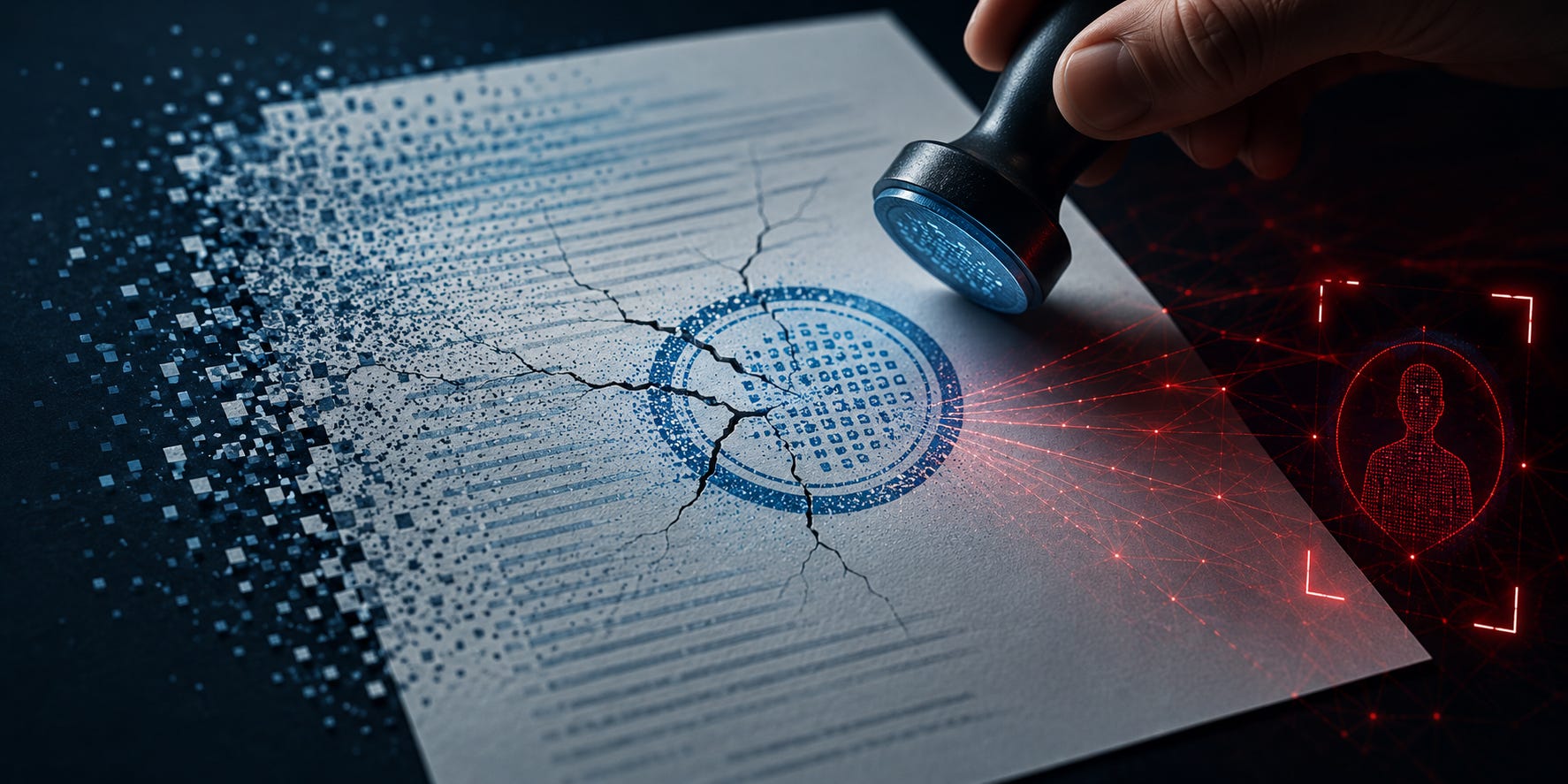
A recruiter opens the four hundredth application of the week some time after nine in the evening, pastes the cover letter into a detector and reads a number. Seventy-eight per cent. She does not know what the number is a probability of, or what the tool’s error rate is on a letter of two hundred words, or whether this candidate wrote the text and had it tidied, or wrote nothing and ran the result through two translations. She knows the number is high. She knows there are three hundred and ninety-nine other letters. She closes the application.
Nobody will ever audit that decision.
Three products shipped into that scene within three weeks. On 23 July 2026 Substack began rolling out Pangram, which returns a score on the likelihood that a published piece was machine written. A week later LinkedIn added a button letting any reader flag a post as AI slop. On 11 August Anthropic announced that every model released after 2 August embeds an invisible watermark in the text it produces, across Claude, Claude Code, Cowork and the API.
The coverage of all three has been approving, and on the watermark I part company with it. Anthropic built a good instrument for a question nobody in a hiring office is asking. It reports, with a stated error rate, whether a model probably touched a text. It will be used to decide whether a person cheated. Anthropic built a thermometer; the market will use it as a DNA test.
Provenance is not responsibility
Nobody clicking one of those buttons wants to know which hands touched a text. They want to know whether they can trust it.
Those are different questions. Provenance tells you where something came from. Responsibility tells you who answers for it, and a signature has never certified manufacture; it certifies accountability, which is why it has always been a legal and social device rather than a technical one. If the piece is useful, the credit belongs to the name at the top. If it contains an error, so does the blame. That arrangement worked for several centuries without any verification technology whatsoever, and it is the arrangement now being replaced by a number.