
When the Vatican reads the source code #98
What Pope Leo XIV's Magnifica Humanitas gets right about the politics of artificial intelligence, and why the AI industry should read it carefully.
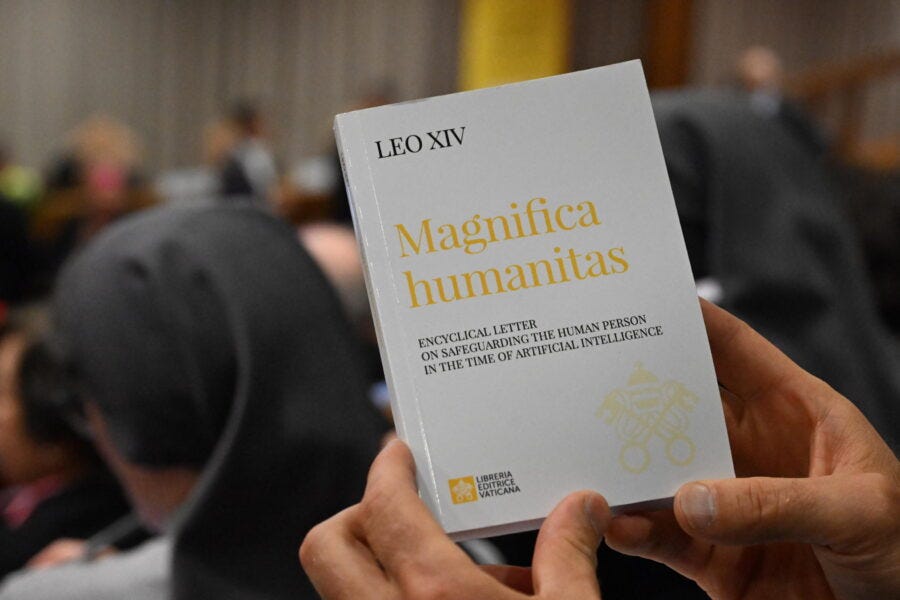

On 25 May 2026, Pope Leo XIV released his first encyclical, Magnifica Humanitas, dedicated to safeguarding the human person in the age of artificial intelligence.
I expected a document of moral concern, perhaps a pastoral exhortation with a few well-chosen cautions. What I found is more demanding: a treatise on power in the algorithmic era, and on the human consequences of that power. The text bears the signature date of 15 May 2026, marking the 135th anniversary of Rerum Novarum, the encyclical with which Pope Leo XIII confronted the social fractures of the first industrial revolution. The parallel is not decorative, it is a thesis.
I want to extract from this document the arguments I consider most consequential, including those that touch questions I have written about for years and that form the core of my latest book. I do not agree with every emphasis in the encyclical, but I find its diagnosis sharper than most of what circulates today inside the AI policy debate. The industry would do well to read it as a serious challenge rather than as a sermon from outside the room.
The honest sentence about how these systems are built
The encyclical contains a phrase I want to highlight first, because it sets the epistemic register for everything that follows: modern artificial intelligences are cultivated more than they are constructed. The formulation is not new in technical literature, but coming from a magisterial document it carries a different weight. It says, in plain language, that the people building these systems do not fully understand them.
This has a consequence the industry continues to underplay. If a frontier model is grown rather than engineered, the rhetoric of human control has to be rewritten. We cannot keep talking about oversight and steering as if we were still in the world of deterministic software with clean input-output relations. We are in a different regime, and the regulatory imagination has not caught up. I have argued in the past that the real risk of AI hype is the erosion of credibility for genuine developments. Magnifica Humanitas refuses both inflation and deflation. It describes the technology as it is.
A second clarification concerns anthropomorphization. The encyclical reminds us that AI does not learn the way a human learns. It adapts statistically. It does not decide by experience, it does not carry the weight of consequences, it does not know what it is doing in any sense a human would recognize. This is technically accurate and politically important. Much of the current confusion about AI ethics comes from importing human moral categories into systems that have no inner life to which those categories could apply.
Universal destination of goods
The most politically ambitious move in the document, and the one I find most interesting, concerns the category of universal destination of goods. This category has historically been applied to land, food, water. Magnifica Humanitas extends it to algorithms, data, and platforms. That is not a rhetorical flourish, it means that the digital infrastructure on which our societies now depend cannot be treated as the legitimate exclusive property of whoever first managed to capture it.
I find this argument convincing. If we accept that algorithms now mediate access to credit, healthcare, education, and labor markets, then treating them as ordinary commercial assets is no longer a defensible position. The encyclical does not propose nationalization. It proposes that the moral status of these goods be reconsidered, which is a more serious request because it is upstream of policy. Whoever owns the infrastructure of decision-making is, in a meaningful sense, exercising public authority, but we have not yet built the institutions appropriate to that fact.
A sharp passage extends this analysis to epidemiological, genetic and demographic data of vulnerable populations, which the document treats as the new rare earths of contemporary power. Whoever holds this data does not merely describe the needs of populations. They model those needs, and then they decide which medicines are developed, which investments flow, which protections are extended. Predictive power, in this sense, is already prescriptive power.
The invisible labor behind the conversational interface
The encyclical labels the invisible workforce of AI as the new slavery. The expression will be uncomfortable for many in the industry, and that discomfort is exactly the point.
Behind every fluent conversational interface there is a long supply chain of human annotation, content moderation, reinforcement learning from human feedback, and trauma absorption. Much of this work is performed under conditions of precarity, in jurisdictions chosen for cost reasons, by workers who do not appear in any company communication and whose names do not enter any product credit. The technology presents itself as autonomous. It is not. It is a sophisticated form of distributed human labor, partially automated, and the asymmetry between the visibility of the model and the invisibility of those who train it is structural.
In my view, this is one of the points on which the AI industry has been most rhetorically dishonest. We talk about scaling laws and emergent capabilities. We do not talk about the people in Nairobi, Manila and Bogotá who categorize hate speech for ten hours a day so that the chatbot can refuse to write it. I would not have chosen the word slavery, because it imports a historical category that does not map cleanly onto the present case, but the underlying critique is correct. The dignity of these workers is the first ethical question of contemporary AI, and we keep skipping over it.
The material weight of an industry that pretends to be weightless
The encyclical insists, with appropriate firmness, that artificial intelligence has a serious environmental footprint. While the industry continues to present AI as an ethereal service, a layer above the physical world, the text returns it to its proper place: data centers, undersea cables, energy-hungry infrastructure, water consumption, rare metals. None of this is news to anyone who has followed the energy debates of the past three years. But it is necessary to keep saying it.
A technology whose marginal energy cost grows faster than the efficiency of its underlying hardware cannot be governed by voluntary commitments alone. Magnifica Humanitas asks for regulation, and on this I agree without qualification. The current trajectory of data center expansion is incompatible with the climate commitments the same companies publicly endorse. Either the commitments are sincere, in which case the trajectory must change, or the trajectory is the truth, in which case the commitments are public relations.
The empathy machine and the erosion of the desire for the other
This is the section of the encyclical I read most carefully, because it touches the question to which I am dedicating an entire book.
The document addresses the simulation of empathy by conversational systems, and the related problem of sycophancy. The risk it identifies is more subtle than the usual one. The danger is not that a person will believe they are speaking to another human being. Most users know they are speaking to a machine. The danger is that, over time, the convenience of a perfectly accommodating interlocutor will erode the desire to seek the other at all. The friction of real relationships, with their disagreements and their refusals and their inconvenient timing, becomes harder to tolerate when an alternative is permanently available that always agrees, always responds, never tires, never asks for anything in return.
I sent the manuscript of Empatia Artificiale to the Holy See several months ago, and I do not know whether the Pope has read it. I notice with some interest that the encyclical converges on conclusions I had developed independently. The question I want to add is one I think the document underplays: if the desire for the other is socially atrophying, the answer cannot be to ban the empathy machine. The empathy machine is here. The answer has to be a cultural project of rebuilding the conditions under which encountering another human being remains valuable and chosen. That is much harder than regulation, and it is also more important.
A frontal attack on the current model of AI safety
The most striking single sentence, for me, is this: an AI is not more moral simply because it is decided by a few who is to be its morality. I am paraphrasing, but the substance is exact. This is a frontal attack on the current model of AI safety, in which ethical principles are defined unilaterally by a small set of laboratories and then presented to the world as universal.
I do not believe that current AI safety work is being conducted in bad faith, the problem is structural. When the parameters of what an AI will and will not say, what it will and will not refuse, what it will and will not assist, are decided inside the engineering organizations that build the systems, the result is alignment to a particular cultural and commercial worldview that then propagates at planetary scale. The technical work is rigorous. The political mandate to perform that work is missing.
The encyclical’s contribution is to reframe the question. The issue is not whether the principles chosen are good or bad. The issue is whether the process by which they are chosen is legitimate. Universalizing the outcomes of alignment is a category error. What needs to be universalized is the procedure by which alignment targets are selected.
Disarming the algorithm
The text uses the expression disarming AI, and clarifies what it does not mean. It does not mean abandoning the technology. It means removing it from the logic of armed competition, which today is economic and cognitive before it is military. The geopolitical race for AI supremacy, conducted between blocs and between corporations, makes responsible development almost impossible, because every safety pause is reframed as a competitive concession.
On lethal autonomous systems, the encyclical is uncompromising: delegating irreversible lethal decisions to systems without moral consciousness is declared inadmissible. The document calls for traceability of decisions, for the possibility of reconstructing chains of responsibility, and for the prohibition of delegating lethal force to opaque processes.
I support this position fully. The argument that autonomous weapons systems will reduce civilian casualties through superior targeting precision is, in my reading, the most dangerous form of contemporary technological optimism. It mistakes a hypothesis for a fact, and it does so on a question where being wrong produces dead people who cannot be brought back.
Educating to fast from AI
The pedagogical proposal of the encyclical is the one I find most original, and I expect it to be most quoted in the coming months. The document asks that schools teach not only how to use these tools, but when and for what purposes not to use them. It calls this fasting from AI, and it places this skill at the center of digital literacy.
This reverses the dominant narrative, in which AI literacy is presented as professional survival, a competence one must acquire to remain employable. The encyclical proposes instead that the deeper literacy is the capacity to decide, in each situation, whether the use of AI is appropriate at all. To write a complex email to a colleague with whom you have a delicate relationship, the AI is a poor choice, because the act of writing the email is itself the work of thinking through the relationship. To make a difficult ethical decision, the AI is a poor choice, because the moral weight of the decision is yours to carry, and outsourcing the formulation is already outsourcing the responsibility.
I have advocated for this kind of disciplined non-use for some time. The schools that will form the next generation of professionals need to teach the discrimination of contexts, not the indiscriminate application of tools. We are training young people to reach for the AI by default. We should be training them to know when the AI is the wrong instrument.
Closing position
The final passage I want to underline is the description of AI as an environment in which we are already immersed, and a power with which we must come to terms. The shift in metaphor matters. A tool can be regulated, set down, picked up at need. An environment is inhabited. We do not negotiate with an environment as an external object. We live inside it, and the question of governance becomes a question of how to live well within it.
I share this framing entirely. The AI policy conversation has spent five years treating these systems as products to be approved or refused, like a new drug or a new vehicle. That model is obsolete. The systems are already integrated into the cognitive infrastructure of contemporary work, education, healthcare, journalism, and political communication. The relevant question is no longer whether to admit them. The relevant question is what kind of cognitive and social environment we want to construct around them, and that question cannot be answered by engineering teams alone, by regulators alone, or by a single institution speaking on behalf of a single tradition.
Magnifica Humanitas will be read, in the AI industry, as an outside document. I want to register my disagreement with that reading. The encyclical is a contribution to the most consequential technical and political conversation of our time, and the fact that it comes from a moral authority rather than from a research laboratory does not diminish its analytical force. The Vatican has read the “source code” of the topic more carefully than most regulators. The industry would do well to read Magnifica Humanitas with the same attention.
(Service Announcement)
This newsletter (which now has over 6,000 subscribers and many more readers, as it’s also published online) is free and entirely independent.
It has never accepted sponsors or advertisements, and is made in my spare time.
If you like it, you can contribute by forwarding it to anyone who might be interested, or promoting it on social media.
Many readers, whom I sincerely thank, have become supporters by making a donation.
Thank you so much for your support!